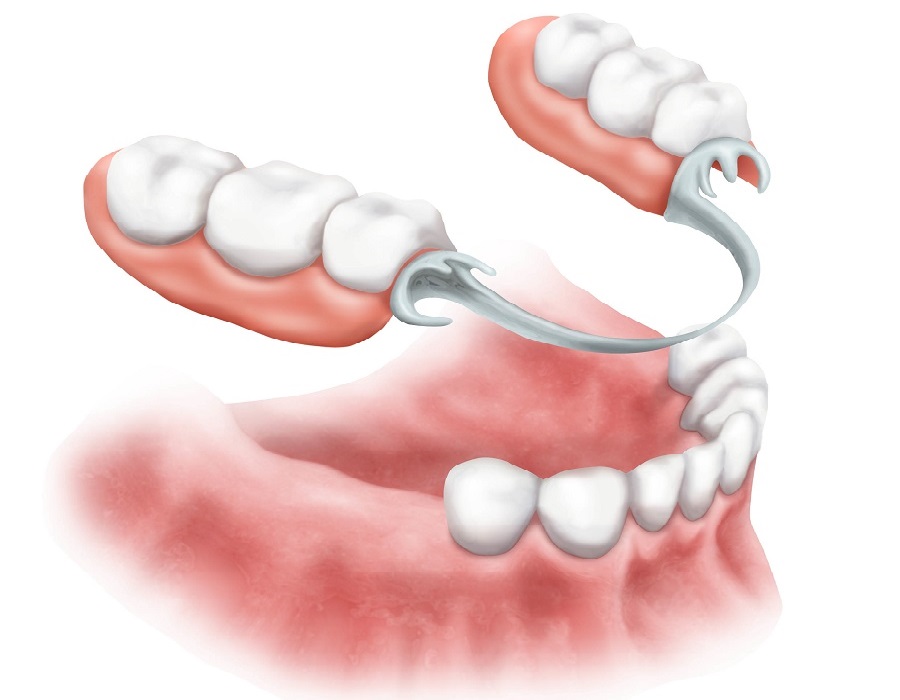
If one or more teeth need to be replaced
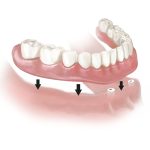
A plate or frame denture, also known as a partial denture, is a replacement of one or more teeth. A good solution if your lost teeth are not replaced by a bridge, crown or implant. You can take the denture out of your mouth. Bridges, crowns and implants cannot. These are fixed in the mouth.
The plate prosthesis
Plate prosthesis from the front
Plate prosthesis from the side
The plate denture is made of a pink, gum-coloured synthetic resin. In it, the artificial teeth are anchored. The entire plate prosthesis rests on the mucosa of the mouth. It may be attached to remaining teeth with anchors.
The frame prosthesis
Framed prosthesis in progress on a plaster model, without artificial teeth and molars
Frame prosthesis with anchorage on crowns
The frame denture is made of metal. A gum-coloured synthetic resin is applied to the metal. On top of this are the artificial teeth or molars. The denture rests mainly on part of the remaining teeth. Depending on the design, the framed prosthesis also rests more or less on the mucosa. The dentist can attach the frame prosthesis in two ways. Either with metal anchors that clamp around some teeth or with a type of clasp. With a clasp, one side is attached to a crown, tooth or molar and the other side is fixed to the frame denture. You can slide the framework prosthesis into the clasp in this way. The clasp is usually on the inside of the teeth and is therefore not visible from the outside. Anchors are often slightly visible.
Differences between plate and frame dentures
A plate denture is cheaper than a frame denture, but then it also has disadvantages. Since the plate denture rests entirely on your gums, it can easily lead to gum problems. This is because your gums have to absorb the force caused by chewing. Also, food easily gets stuck under the plate denture. This leads to gum inflammation more quickly. The frame prosthesis rests largely on your remaining teeth and to a lesser extent on the gums. As a result, your natural teeth absorb the chewing forces and the gums are spared more than with a plate denture. Which one is most suitable for you varies from person to person. The choice is made in consultation with your dentist.
Making a plate or frame prosthesis
Depending on whether your dentist is fitting a plate or framed prosthesis, he sometimes files the teeth or works on them in another way. He then takes impressions of your jaws. This is done using an impression tray filled with a special impression material. In the dental laboratory, that impression is filled with plaster. This creates a plaster model. A well-fitting impression tray is then made of synthetic resin. Another impression is taken with this tray to obtain an even more accurate plaster model. Your plate or frame prosthesis will be made on this. In total, you will need five or six dental visits for the customisation of the plate or frame denture. All in all, it takes about five weeks. For the frame denture, the customisation usually takes a few weeks longer.
The first days with a plate or frame prosthesis
A few days after the dentist places the plate or frame prosthesis in your mouth, he checks the fit. You may still talk a little uncomfortably when you are just wearing the denture. Some sounds may sound slightly different. This is normal and will go away by itself. You just need to get used to the plate or frame prosthesis. Do symptoms persist? Then contact your dentist. If your denture fits well, the dentist will check it during the six-monthly check-up.
Cleaning of a plate or frame denture
Clean your dentures after every meal.
Especially under your plate or frame denture, a lot of food residue can remain. So clean your denture well after every meal with a special denture brush, e.g. from Lactona or Oral-B, and water. Do not use toothpaste. It can be too abrasive. Also clean the mucosa under your plate or framework denture (your jaw, palate and the transition from the jaw to the cheeks) and brush your own teeth carefully. Use an ordinary soft toothbrush with fluoride toothpaste for this purpose. Pay extra attention to removing plaque. Especially on those teeth on which your denture rests. Your dentist or dental hygienist can inform you about this.
Clean your dentures daily with a cleaning agent available from a chemist or pharmacy. Follow the manufacturer's instructions. If necessary, ask your dentist or dental hygienist for advice. Be sure to soak your dentures in a cleaning solution overnight once a week. This will prevent tartar build-up on your dentures. Then brush your dentures thoroughly and rinse them with water. Never soak your dentures in hot water and never use bleach or abrasive cleaners.
Should I take off the plate or frame denture at night?
Some people grind their teeth in their sleep or press the molars firmly together. This can put undue pressure on the plate or framed denture and the gums. In addition, the gums recover better at night if you remove the denture. Consult with your dentist about the best thing to do.
Don't have the denture in your mouth? Then keep it in a glass of water. Change the water every day. You can also keep the denture in a glass filled with detergent. Always rinse the denture well with water before placing it back in your mouth.
Want to know more?
Then download the free GezondeMond app. The app is available for Android and tablets, available via Google Play. The app for iPhone and iPad can be found in the iTunes App Store..