
Inflamed dental tissue no longer heals
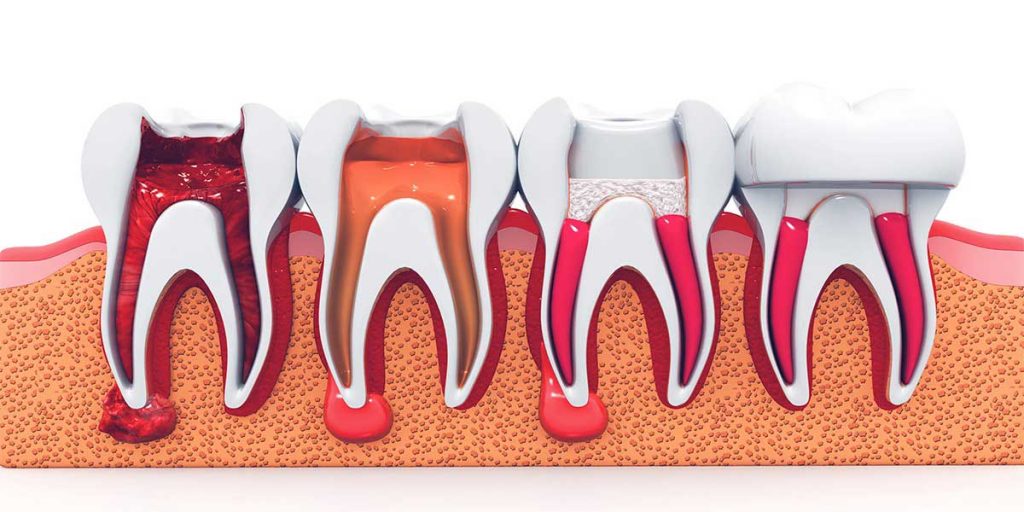
Teeth consist of a crown and one or more roots. The crown is the part you can see. The roots are not visible. They are anchored in the jawbone beneath your gums. Each root has a canal, called the root canal. This canal contains nerve fibres and small blood vessels. This living tissue is also known as pulp. If the tissue is inflamed or has been inflamed, the dentist will perform root canal treatment.
What causes inflamed dental tissue?
Tooth decay or a leaking filling can cause your tooth tissue to become inflamed. A hard blow to your tooth can also be a cause. Bacteria are usually the cause of the inflammation. Do your teeth feel sensitive when drinking cold or hot beverages? That could be an early sign. Sometimes the inflammation causes no symptoms, but severe pain can also occur. Your dentist must remove the inflamed tooth tissue, otherwise it will die. If the tooth tissue is not removed, the inflammation can spread to your jawbone. This can cause the jawbone around the teeth to deteriorate. Eventually, so much jawbone can be lost that the teeth become loose or even fall out. You will notice jawbone inflammation when you bite down. Your tooth may feel too high.


What happens during root canal treatment?
2 Root canals are sealed with filling material and the tooth is filled. After a considerable period of time, the inflammation has disappeared.
During root canal treatment, the dentist removes the inflamed tooth tissue. Inflamed tooth tissue cannot heal. It is an irreversible process. That is why your dentist removes the inflamed tissue. Root canal treatment is also known as canal or nerve treatment.
Root canal treatment
Root canal treatment is performed under local anaesthetic if your tooth tissue is still (partially) ‘alive’. Anaesthetic is sometimes not necessary if your tooth tissue has already died. Your dentist will often take one or more X-rays. This allows them to monitor the progress of the treatment closely. Your dentist will first open your tooth and remove the inflamed tissue. He will then clean the canal with small files and rinse it with a disinfectant solution. The canals are then filled. After the root canal treatment, your dentist will close your tooth with a filling. If the tooth is weakened, a crown may be necessary. A tooth that has been treated in this way can last for a long time.
Can root canal treatment be performed on any tooth?
Sometimes your dentist cannot perform root canal treatment because there are additional problems. It may be necessary to remove the tooth. You can discuss possible solutions for replacing your lost tooth with your dentist. Consider, for example, a bridge.
Is root canal treatment painful?
Root canal treatment is usually not painful when anaesthesia is used.
How long does root canal treatment take?
The duration of root canal treatment depends on the number of root canals. Teeth usually have one root. Molars often have more. The treatment time therefore varies from half an hour to an hour and a half. The dentist can often complete the root canal treatment in one visit. Sometimes you will need to return several times.
Does root canal treatment cause pain afterwards?
Na het reinigen van de wortelkanalen kunt u eventueel napijn krijgen, die enkele dagen kan aanhouden. U kunt de napijn met een goede pijnstiller onderdrukken. Een antibioticum is meestal niet nodig.
Will a tooth discolour after root canal treatment?
A tooth does not usually discolour after root canal treatment. If some discolouration does occur, your dentist can usually remedy it. There are various options available for this. Ask your dentist for advice.
Want to know more?
Then download the free app GezondeMond. The app is available for Android and tablets, available via Google Play. The app for iPhone and iPad can be found in the iTunes App Store..