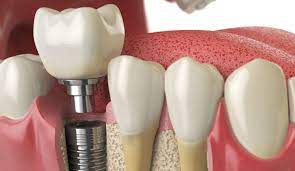
What is an implant?
A root with molar
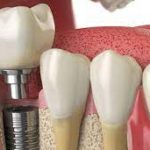
An implant with crown
An implant is best compared to an artificial root. An implant replaces an absent tooth root and is inserted into the jaw like a screw. Implants are made of a body-friendly material such as titanium. Sometimes they are coated with a ceramic layer.
The implant provides support for a crown, bridge or overdenture.
When are implants applied?
One tooth was replaced with an implant and crown
Three molars replaced with two implants fitted with a bridge
One bridge on six implants
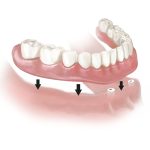
Two interconnected implants serve as anchors for the overdenture
- When one tooth or molar is missing. The dentist places a crown of metal or ceramic on the implant.
- When some teeth are missing. In this situation, the implants are provided with a fixed bridge. A bridge is a non-removable replacement of one or more missing teeth and/or molars for the patient.
- If all teeth are missing, an overdenture can be placed on implants (usually two). This is clicked onto the implants.
When is implant treatment possible?
In principle, anyone with mature jawbone (from about eighteen years of age) can have an implant placed. For successful treatment, however, you must meet some conditions:
- You must have sufficient jawbone to anchor the implants.
- Your jawbone should be healthy.
- The gums of the remaining teeth should be healthy. If this is not the case, it will be treated first.
- You must be prepared to properly maintain the fitted facilities.
The dentist uses X-rays to assess whether you have enough jawbone and whether it is healthy. Nowadays, it is possible to create new jawbone in places where there is too little of it.
- Smoking and excessive alcohol consumption are highly detrimental to treatment success.
How does implant treatment work?
- Implant site
- Gums are loosened
- A hole is drilled into the bone
- The implant is inserted
- Gums are sutured
Two ways of insertion
- The implant is visible in the mouth (protrudes through the gums). The dentist no longer needs to open the gums when fitting the crown, bridge or prosthesis.
- The implant is locked completely under the gums after insertion. This approach causes less post-operative pain. In addition, there is less risk of infection. The gums are reopened when the crown, bridge or denture is inserted.
Your dentist or oral surgeon will discuss with you which approach is best in your situation.
The dentist or oral surgeon inserts the implants.
- First, you will be given a local anaesthetic around the implant site.
- Then the gums at the site where the implant is to be placed are loosened, revealing the jawbone.
- A hole is then drilled into the jawbone.
- In it, the implant is screwed or tapped.
- The gums are then sutured.
If you need more than one implant, they are almost always inserted during the same treatment.
After insertion of the implants
A piece of gum tissue is removed
The crown is placed on the implant
Experiences with the treatments are mixed. The bone itself has no sensation, but the gums can be slightly painful. For this, you will be prescribed a painkiller if necessary.
It is often wise to adjust your diet for one or two weeks after implant placement. Do this in consultation with your dentist or oral surgeon. Three to six months after insertion, the implant is firmly anchored in the bone. You should not put any weight on the implant during this period. A temporarily placed appliance ensures chewing function and aesthetics as much as possible.
After one or more implants are anchored in the jawbone, the dentist places the crown, bridge or prosthesis on them. To do this, he sometimes first removes a small piece of the gums above the implant under local anaesthesia.
Oral hygiene with implants
Brush the pillars and gums with a soft toothbrush and toothpaste
An implant under a crown or bridge is anchored in the bone. It is very important to properly clean the transition from the crown or bridge to the gums. Brush this area carefully with a soft toothbrush and use toothpicks, brushes and/or dental floss. Poor oral hygiene can cause you to lose your implant.
Implants that serve as pillars under overdentures should be cleaned with a soft toothbrush, brushes and/or (super)floss. Brush the part of the implant that protrudes above the gums twice a day. Pay special attention to the transition from the implant to the gums. Clean the area under the splint with brushes and/or super floss as directed by your dentist or dental hygienist. If you do not remove food particles and plaque around the implants, the gums will become inflamed. As a result, they eventually lose their hold, become loose and can cause pain.
Implant aftercare
Good daily oral hygiene and regular dental check-ups are necessary after your implant is placed. The dentist or oral surgeon will indicate when he wants to see you again for check-ups. During the check-up, the dentist pays attention to:
- The health of your gums.
- The situation of the jawbone around your implants.
- Wear of the crown, bridge or denture.
Cost of implants
What you have to pay for treatment depends on the scope of work and your health insurance. Ask your dentist or oral surgeon for a quote and always discuss it with your insurer.
Want to know more?
Then download the free app GezondeMond. The app is available for Android and tablets, available via Google Play. The app for iPhone and iPad can be found in the iTunes App Store..
© Ivory Cross